
Electrical isolation in Advanced Panel Meters (APMs) is fundamental to maintaining safe and accurate power measurement in industrial control panels. In environments where mixed voltages, long cable runs, and high-current equipment coexist, unmanaged electrical paths can introduce noise, ground loops, and damaging transients. Understanding how isolation works inside both signal conditioners and APMs helps ensure reliable monitoring and long-term system stability.
The Role of Isolation in APMs and Signal Conditioning
In control panels, electrical signals rarely operate in isolation. Noise, ground potential differences, and transient surges are common, especially in environments with mixed voltages, long cable runs, or nearby high-current equipment. Left unmanaged, these conditions can compromise measurement accuracy, damage equipment, and increase troubleshooting time.
For this reason, electrical isolation plays a critical role in both Signal Conditioners and Advanced Panel Meters (APMs). While these devices serve different purposes, they work best when their isolation strategies are understood together.
Isolation and Signal Conditioning: How They Work Together
Signal conditioners are typically used to prepare sensor signals before they reach downstream devices. They may scale, convert, or stabilize raw sensor output, so it can be read reliably by meters, PLCs, or control systems. If you’re new to signal conditioners or need a refresher, learn more here: How to choose the right signal conditioner for your control panel.
Even with proper signal conditioning, measurement integrity can still be compromised once the signal enters the panel if electrical paths are not adequately separated. This is where isolation inside the APM becomes essential, helping preserve signal quality and prevent interference from other circuits.
What Electrical Isolation Does in Practice
Electrical isolation prevents electrical noise, surges, or ground faults in one part of a system from affecting other parts. By electrically separating circuits, isolation helps contain disturbances instead of allowing them to propagate through the system.
In practical terms, isolation helps:
- Improve measurement accuracy by reducing noise interference
- Protect equipment from unexpected voltage differences or faults
- Increase overall system reliability and safety
This becomes especially important in panels where power inputs, voltage signals, current signals, and digital outputs all coexist.
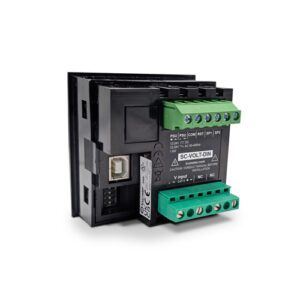
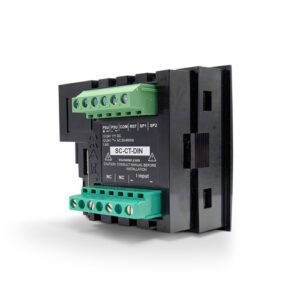
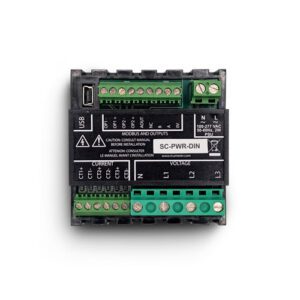
Understanding Isolation in Trumeter APMs
Not all APMs isolate signals in the same way. Different applications require different isolation strategies, depending on how power, voltage, current, and outputs interact within the panel.
In applications where voltage and current are measured together, these inputs may share a common reference while remaining isolated from power and output circuits. Understanding this relationship is important when integrating signal conditioners, managing grounding schemes, and ensuring predictable measurement behavior in the panel.
For a model-by-model breakdown of isolation, view the APMs Isolation Reference in the Trumeter Knowledge Base.
Why This Matters When Designing a Panel
When isolation is properly applied, faults and noise are contained rather than spread, making systems easier to maintain and more predictable over time. It’s a design consideration that directly affects how a panel behaves once it’s powered, commissioned, and operating under field conditions.
When APM isolation is aligned with appropriate signal conditioning upstream, panel designers gain:
- More stable and trustworthy measurements
- Fewer grounding and noise-related issues
- Reduced troubleshooting during commissioning and operations
Understanding how isolation is implemented inside the meter is just as important as choosing the right sensor or signal conditioner, especially in applications where accuracy and reliability are critical.
